
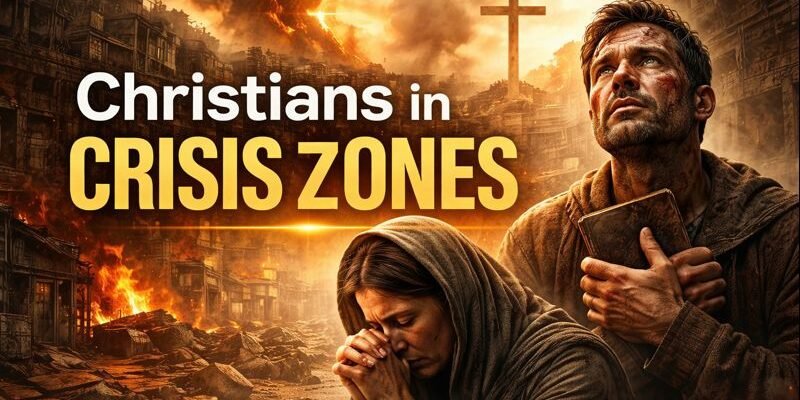
Across the world today, millions of Christians live and worship in regions marked by conflict, instability, and fear. These crisis zones may be shaped by war, political upheaval, religious persecution, natural disasters, or economic collapse, yet within them the Christian faith continues to endure in remarkable ways. For believers in these regions, faith is not merely a personal comfort or cultural identity but a daily act of courage. Church gatherings often take place in secret, prayers are whispered instead of spoken aloud, and Scripture is treasured as a lifeline rather than a convenience. The reality of Christian life in crisis zones challenges the global church to reconsider what it truly means to follow Christ under pressure.
In many crisis zones, Christians face threats not only to their freedom but to their very lives. Armed conflict can turn once-peaceful communities into battlegrounds, forcing families to flee their homes and abandon everything familiar. In some regions, believers are targeted specifically because of their faith, viewed as outsiders or enemies within their own nations. Churches are destroyed, pastors are imprisoned, and entire congregations are scattered. Yet even in these conditions, stories continue to emerge of believers choosing forgiveness over revenge, prayer over despair, and faith over fear. Their witness reflects a deep-rooted trust in God that does not depend on safety or stability.
Economic hardship further intensifies the struggles faced by Christians in crisis zones. War and unrest often destroy local economies, leaving families without reliable access to food, clean water, healthcare, or education. For Christian communities already marginalized, opportunities for work and aid can be even more limited. Despite these challenges, churches frequently become centers of support, sharing scarce resources and caring for the most vulnerable among them. This quiet generosity, offered in the midst of personal loss, reflects the heart of the early church and demonstrates a faith that is active even when circumstances are harsh.
Spiritual resilience is one of the most striking characteristics of Christians living in crisis zones. When life itself feels uncertain, prayer becomes a constant companion rather than a scheduled activity. Worship may happen in homes, refugee camps, or hidden spaces, yet it carries profound depth and sincerity. Believers cling to Scripture promises with an urgency that comes from lived experience, finding hope in passages that speak of endurance, deliverance, and God’s nearness to the brokenhearted. Their faith is often stripped of excess and reduced to its core, revealing a powerful dependence on God rather than on comfort or routine.
The suffering of Christians in crisis zones also raises difficult questions for the global church. It challenges believers in more stable regions to move beyond distant sympathy and toward genuine solidarity. Awareness, prayer, and compassionate action become vital expressions of unity within the body of Christ. While solutions are complex and often slow, standing with persecuted and displaced believers affirms that their suffering is neither unseen nor forgotten. Their stories remind the wider church that faith is not measured by ease or success but by faithfulness in the midst of trials.
Ultimately, Christians in crisis zones embody a living testimony of hope under pressure. Their lives reflect the reality that faith can survive, and even flourish, in the most difficult conditions. While their circumstances may appear fragile, their trust in God often proves unshakable. As the global church listens to their voices and learns from their endurance, it is reminded that the message of Christ was born into hardship and continues to shine brightest in the darkest places. Their witness calls believers everywhere to deeper prayer, greater compassion, and a renewed commitment to live out faith with courage and conviction.
by Jordan A. Wells